Showing posts with label ilocos. Show all posts

Wednesday, September 7, 2011

Paoay Church in Ilocos Norte » Architectural Heresy and Our Obsession with Heritage

I had already poked my head into enough elegant churches in Bohol and other old towns in the Philippines but I should not miss Paoay Church, although I used to think all Spanish-era churches in the Philippines are alike. San Agustin Church in Ilocos Norte, popularly known as Paoay Church is definitely unique.  

The uniqueness of this church lies in the unceasing nature of its struggles against time and the history it depicts, in its dramatic architecture and the mysterious heresy hidden within its elaborate brick design.
 
I approached the church from a nearby dry and impotent brick fountain, excited like a virgin bride walking at the long patio decorated by white bougainvilleas at each side. Waiting for me at the other end is the pyramidal and deliberately flat church façade like an unlit altar, gray yet graceful against Ilocandia’s arid air. Above me are dark clouds stripped of its silver lining, painted like the church’s high frescoes, tragic like the life of Judas.

View of Paoay Church from the fountain
But halfway through the patio, I heard it. This church is whispering heresies of the past. Its fourteen buttresses are like old papyrus, documenting the fusion of the conquistadores and the pagans.

Sic transit gloria mundi,” thus passes the glory of the world, wrote the monk Thomas à Kempis. The survival of churches through time, architecturally and historically, is a subject matter for the architects and historians. My reaction or theory about this specific church, about it being architecturally heretic is mine alone. But let me expound.

Paoay Church history


The Official Marker: WORLD HERITAGE SITE, Church of San Agustin Paoay Ilocos Norte. One of the four Baroque Churches of the Philippines inscribed in 1993 on the World Heritage List pursuant to the 1972 UNESCO Convention Concerning the Protection of the World Cultural and Natural Heritage. The Church of San Agustin possesses exceptional universal value the deserves protection for the benefit of humanity. 
Paoay Church is part of the UNESCO World Heritage List, under the Philippines four Barqoue Churches collection composed of San Agustin Church in Manila, Nuestra Señora de la Asuncion in Santa Maria, Ilocos Sur and Sto. Tomas de Villanueva Church in Miag-ao, Iloilo. It is currently a property of the Diocese of Laoag, Ilocos Norte.

Church main altar and roof under renovation
According to the official historical marker at the entrance of the church, the parish was founded by Augustinian missionaries in 1593, cornerstone of church laid 1704; of convent, 1707; of tower, 1793. It was used before completion and kept in repair by the people under joint auspices of the Church and the town officials. An inauguration ceremony was held 28 February 1896.

The bell tower
It was damaged by earthquake in 1706 and 1927. Katipuneros used its tower as observation post during the Revolution and by Guerilleros during the Japanese occupation in World War II.    

The massive coral stone bell tower, which was added half a century after the church was completed, stands at some distance from the church, again as a protection against damage during earthquakes.
According to historians, the bell tower also served as a status symbol for the locals. The bell would ring more loudly and more times during the wedding of a prominent clan that it would during the wedding of the poor.

Earthquake Baroque

As reported by Jorge Gazaneo of ICOMOS, “Philippine church is a completed example of one are peiod, but a living document of how time and context have left traces on the early founding intentions of the original designer-builder… on the cross roads of different cultures – Malay, Chinese, European, American, Mexico-Peru – the architecture and art of the Philippines should be valued on standards different from those developed by European Scholars…Unity and authenticity are difficult to be expected in theis part of the world, a violent frontier knowing the ravages of war, heavy typhoons and repeated violent earthquake destruction.”

Paoay Church is the most outstanding example in the Philippines of 'Earthquake Baroque' due to its unique combination of Gothic and Oriental designs. Its façade reveals Gothic designs, its gables show Chinese elements, while the niches topping the walls suggest Javanese influence like the towers of the famous Boroboudur Temple in Central Java, Indonesia. It is interesting to note that the town of Paoay is called "Bombay" in early documents, in keeping with the legend that the earliest inhabitants came from India.

Javanese influence on the Church's buttresses like the towers of the famous Boroboudur Temple in Central Java, Indonesia.
It has fourteen buttresses ranged along the lines of a giant volute supporting a smaller one and surmounted by pyramidal finials. Its details are inspired by the seal of Saint Agustine, the emblem of the king of Spain, the logo of the Pope, the “init-tao” or the sun god, and stylized Chinese clouds.

Fusion of the obvious

Because of its difficult terrain, arid temperature and threat of earthquakes, Ilocos was once described as a “God-forsaken land” and it is said that you have to have the “patience of a spider” in order to survive it. But Ilocanos, hardy people that they are, not only survived in this formidable land but were able to turn this highland country into “God’s own paradise”.

It is but fitting that they dedicate their church to St. Augustine. Aurelius Augustinus Hipponensis (St. Augustine), the philosopher, spoke with mechanical fluency when he proved in his book “The City of God [against the Pagans] (Book III)]” that external and bodily disasters including moral and spiritual calamities are happening to the Romans; and that even when the false gods were worshipped without a rival, before the advent of Christ, they afforded no relief from such calamities.

 
Naturally, they build Paoay Church to withstand and defy acts of God. The Augustinians forced the naturally-born pagans to build this church. But these converts have their own memory and obsession with heritage, beliefs and superstitions, thus the Javanese, Chinese and Oriental influences in the design. 

Until now, the picturesque front garden of the San Agustin Church is being used for rituals known as the Guling-guling festival, an annual festivity that signifies the last day of merrymaking before the Catholic community's observance of the Lenten Season. There are those who conjecture that there is probably a pagan underpinning to the practice, similar to Valentine’s Day; the tradition that places the birth of Jesus in late December, the darkest time of the year; and the timing for Easter right after the vernal equinox. 

Paoay Church is truly the fusion of Catholicism and the pagans.


Final Note

New developments are under way for Paoay Church aside from restoration, which aims to make the province of Ilocos Norte the country’s “northern gateway.” To generate more tourist activities, the provincial government of Ilocos Norte announced a plan to put up a commercial arcade, which would feature the town’s unique products along a stretch of the road lining the Paoay Church.

Aesthetically, I don’t know if these commercial establishments will do any good, so you have to visit Paoay before it becomes a commercial-church. 
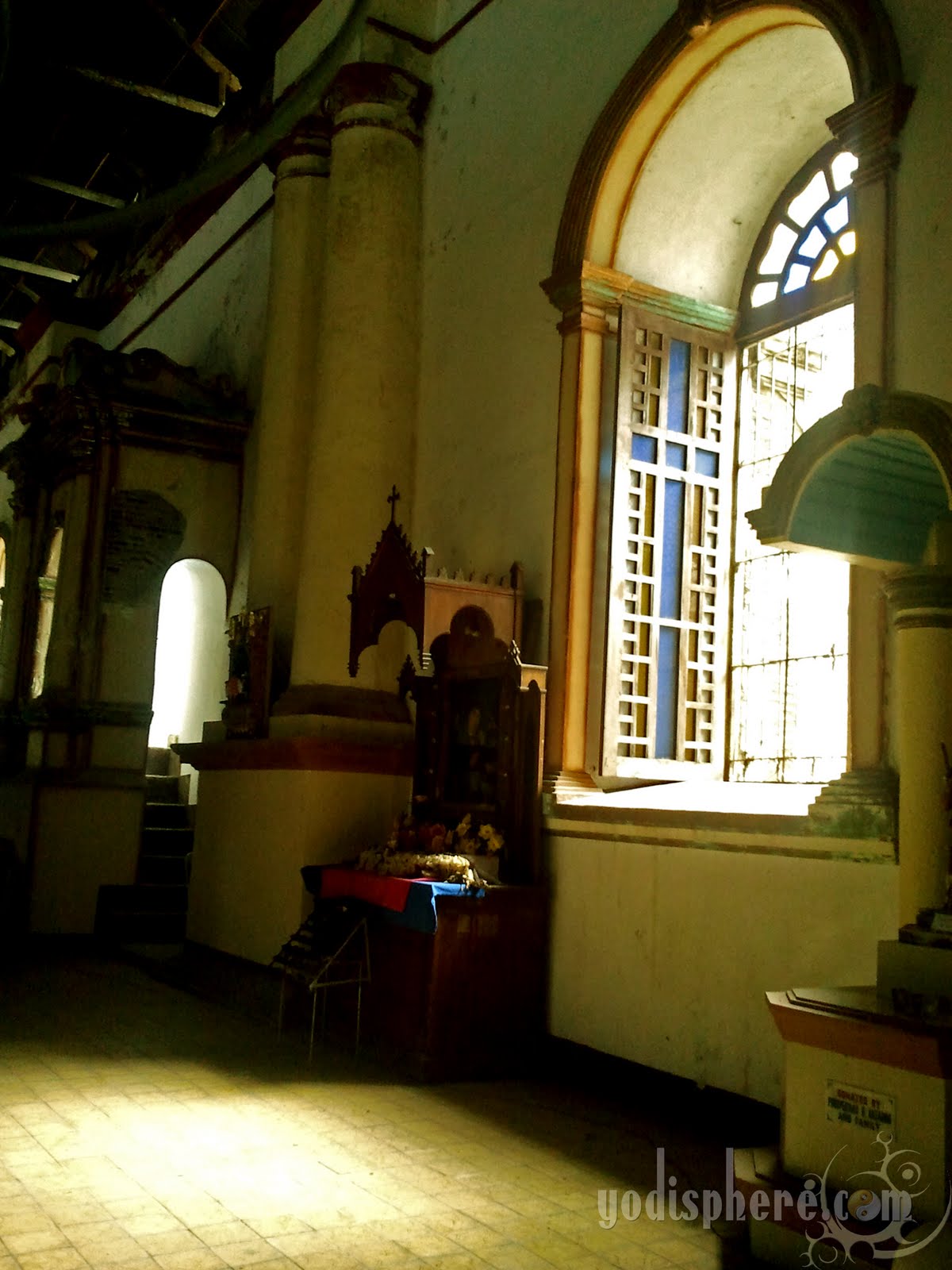

We, Filipinos are always trying to find what old memories look like… our obsession with heritage is always there, searching within the artificial and re-engineered versions created by our invaders.

Paoay Church does renders Ilocandia as forever enchanting and continues to make its visitors have a taste of past life back in times like in the decade when it was first completed.
 

Back in the days, when Filipinos are born pagans.


___________________________________
HERE ARE THE DETAILED POSTS ABOUT OUR  Ilocandia Time Travel


___________________________________
References and Citations:
» Wikipedia Entry “Paoay Church” [Retrieved: 05 September 2011]
» UNESCO Advisory Body Evaluation. Baroque Churches of the Philippines [Retrieved: 05 September 2011]
» Patrimonium-mundi.org : Paoay Church panophotographies - immersive and interactive spherical images
» St. Augustine. Aurelius Augustinus Hipponensis.  “De Civitate Dei contra Paganos [Concerning the] The City of God [against the Pagans] (Book III)]” Translated by Marcus Dods. From Nicene and Post-Nicene Fathers, First Series, Vol. 2. Edited by Philip Schaff. (Buffalo, NY: Christian Literature Publishing Co., 1887.) Revised and edited for New Advent by Kevin Knight.
» Boredpanda.com “50 Most Extraordinary Churches of the World
» De Jesus, Noel F. Manila Bulletin “Charms of the Old World” Posted: June 5, 2011, 10:58am [Retrieved: 05 September 2011]
» The Philippine Star. “Guling Guling of Paoay: Truly a galing galing festivity!” Updated March 06, 2011 12:00 AM [Retrieved: 05 September 2011]
» Rene Guatlo “Paoay sways to Guling Guling” Inquirer Lifestyle. Philippine Daily Inquirer. 03/15/2009.
» CBCP News “300-year old Paoay Church to get facelift” Posted: March 15, 2011
» ALL PHOTOS on this post are taken by the author YODZ Insigne via Samsung Galaxy S Smartphone 


Friday, June 17, 2011

Allegory of the Bantay-Abot Cave and Timmangtang Rock » Is there such a thing as end-of-the-road?

"When you're at the end of the road, And you lost all sense of control, 
And your thoughts have taken their toll, When your mind breaks the spirit of your soul
Your faith walks on broken glass, And the hangover doesn't pass, Nothing's ever built to last
You're in ruins"
[21 Guns – Green Day]

They are wrong. It is not a "Lover’s Rock," it is a metaphorical monument for our wrong choices in life. Bantay Abot Cave and Timmangtang Rock are solid reflections of us being victims of our own poor choices. Sometimes in our foolish search for greener pasture, adventure and material happiness we struggled to leave the protection and safety of the cave only to get stuck in the middle of nowhere, drowned by the sea of human ambitions, leaving us confused and beaten.

But would you rather leave and experience pain than stay? How would you know what’s the right choice? Is there such a thing as end of the road? Ahhh, another bouts of my dusty foot philosophy. Allow me to expound.

The prodigal rock


Timmangtang rock is like the prodigal part of the Bantay Abot Cave. He left the cave for foolish adventure, only to get stuck a few kilometers away from the protection of the cave, now immobilized along the shore and partly by the sea. This sad rock is now looking at the cave, longing to fill that hole he foolishly created when he left, longing to come back but he can’t, even if he is so near. That is the prize he pays for the poor choices he made. Then like the Timmangtang rock I realized that life is a one-way ticket – there’s no coming back.   

That feeling of apprehension was what struck me on that particular day on our Ilocos tour as I approached and captured that scene along the seacoast of Sitio Gaoa, Balaoi, Pagudpud, Ilocos Norte. It wasn’t really intentional and I actually hate it when I see things differently. But I can’t help it, and maybe that’s the whole point of this mania for wandering. We travel to see things differently – others are just afraid to admit that.   


Or maybe I travel to hunt and confront my own demon, because you can actually find your demon in some tropical paradise – those self-righteous priests who told us demons are in hell are fools. However, that thought makes me feel unsettled because when I find my demon I am not sure what to do with it. Say hi perhaps? Ask for guidance or wrestle with it? Because the last time I met my demon, it almost killed me by stoning me with regrets.

The hole in the mountain

On the far side across the dark waves is the Bantay Abot Cave. It is not your typical cave but actually a hole in the foot of the mountain like a mysterious gateway to the netherworld or some unknown universe. Then again I put the meaning of this cave into question.
I put the pieces together and realized that this hole was left by Timmangtang rock in his pursuit for pleasure, which bring him pain and misfortune. If we carefully examine this metaphor we will realize that we are actually connected with each other.

Ironically, when we try to get away from the discomfort by pursuing the supposed solutions we crafted, or to just pursue that nagging sense of adventure, we leave a hole in the heart and soul of those we left behind. So precious we are, in our physical imperfections - unique in our myriad selves that we leave behind us a gaping void when we breakaway for whatever reason. Sometimes it becomes like a tiny black hole, a vortex that can pull demons.

As long as we pursue the false hopes of finding happiness on worldly attachments, as long as we flee the infinite stillness that our personal cave can offer, how can this emptiness, this hole we created by separation be truly filled?


Many died without finding that missing piece, leaving this physical world without really discerning the true image of the puzzle.

But some find the answer and filled that echoing emptiness. How they do it, I don’t know.

Like a liar

So would you rather leave the cave and explore the world? If you find there’s really that end of the road would you come back?

And, if you return what would you find? Who would be there, at the center of the hole you created?

Maybe the pursuit of such questions in contemplation while visiting places will give us some answers.

Or we will end up "like a liar looking for forgiveness from a stone…."


____________________________________
HERE ARE THE DETAILED POSTS ABOUT OUR  Ilocandia Time Travel

_________________________________
Citations and Notes:
» Ending quotation was lifted from the lyrics of the song "21 Guns" by Green Day
» All photos are taken by the author: Samsung Galaxy S mobile phone photography
» Note: This post is the last part of the PAGUDPUD TRICYCLE TOUR SERIES.(Part III of III)


Monday, June 13, 2011

Magical Blue Lagoon and the Cascading Agua Grande » Pagudpud Tricycle Tour Pit Stop


In the center of the mountain’s embrace forming half circle, blanketed by random greenery upon the azure sky fighting the gray clouds, there is a lagoon, and there on its center is the mystical blue riding the sea ripples from its pulsating heart. I look upon it and thought that mystical knowledge was hidden beyond it, like a deja vu of an oblivious soul who has known many things that the years had hidden.

I only had a quick peek at this half-moon shaped bay called Blue Lagoon in Pagudpud but I remembered it as “magical.” The sad fact about travel is that you always had very limited time, but it makes the experience more exciting. This lack of time and hurried glimpse against this magical lagoon was like looking through the eyes of Aragorn when he is looking at Arwen, the Lady of Rivendell – always bestowing an aura of hurried admiration, trying to imprint that awe-inspiring, almost numinous portrait on that quick glimpse.


And Aragorn said: 'Now I know what you bear. Bear it still for me a while!' And he turned and looked away to the North under the great stars, and then he fell silent and spoke no more while the night's journey lasted.

("The Passing of the Grey Company," The Return of the King)  

Panoramic view of the Blue Lagoon at Pagudpud, Maira-ira point: 


Maira-ira, a name that sounded like a ritual tribal hym, is the name given to Luzon mainland's northernmost tip. At its embrace is this cerulean waters, known simply as Maira-ira Point or Blue Lagoon. Its jovial waves are untiringly kissing its fine sand, which is better than its well-known sister Saud Beach (also in Pagudpud).

Located in Malingay Cove in Sitio Malingay, Blue Lagoon is beautiful on its isolation. No beach front hotels and resorts, partying beach combers and unruly commercial enterprises. It might be perfect for nudists finding a mystical nude beach.  


The sun was about to set when we got there, casting our long shadows against the fine sand yellowed by the dying sun rays. Gray clouds are also teasing us, they hung low as if trying to compete with the lagoon's beauty, casting curses and warning if we embrace the lagoon and swim - and so we didn't.    

We just stand there transfixed, like idiots trying to comprehend the mysterious whispers of the Blue Lagoon. 

I will never ever comprehend it, so I just painted its magic on my memories and left.


THE CASCADING AGUA GRANDE

OK, enough of my senti Blue Lagoon rants. Here, let me also share a quick peek at the Agua Grande Picnic Park which is also part of the tourcycle quick pit stop. Agua Grande is a river park situated about 1 kilometer from the Patapat Viaduct also set at the foot of the scenic North Cordillera mountain range against the white waves of the open South China sea. 

Aside from the scenic sea, also part of the attraction is the Agua Grande River (known in Ilocano as dakkel a danum). It is also known for its eco-friendly and non carbon producing mini-hydro electric power plant constructed during the Marcos years and has a power generation capacity which can supply electric power to some 17,000 households in Pagudpud and nearby villages in Pasuquin and Bacarra.  
At the entrance along the highway is the Chapel of Nuestra Señora de Visitacion de Piat where the Marian Movement of Pagudpud meets regularly. The Chapel is just a small unadorned hut for the faithfuls to pray and for a quick keep-us-safe prayer for the Catholic tourists.   

There is also an information desk at the entrance which is abandoned during our visit. Posted on the nearby tree are the entrance fee rates for children and adults. From the outside, you can already see what Agua Grande can offer - just a perfect view under the towering coconut trees and a nice dose of fresh air.    
Main attraction of the Agua Grande picnic park is the cascading water against gray boulders falling to the sea like reclined waterfalls. There are also picnic huts if you want to stay in the place probably awesome for a nice round of vodka and some hotdogs. 

PAGUDPUD TOURCYCLE  QUICK INFO:

Before my final Pagudpud tour post, let me insert here some quick info about what the Pagudpud tourcycle can offer. 
The tourcycle is divided into Southbound and Northbound Tour. I almost covered main Northbound destinations which you can check on my previous posts. 

We visited the Southbound destinations on our own since we rented a van and I think it's a little far from Pagudpud if you are staying there. 

The Pagudpud tourcycle is very organized. You can find info cards and official ID of your driver inside the tricycle plus they are very courteous and eager to show you your destinations. You can even ask them some local facts and info if you are a blogger and also are very much willing to be your official group photographer during the tour. 
   
The tricycle for the tour
Last part of the series of posts about our Pagudpud tricycle tour pit stop will be the quick emo trip at Timmangtang Rock and exploring the giant doughnut Bantay-Abot Cave so watch our for that to complete my tourcycle coverage. 

Till then!
Hit comments if you've been to this part of the Philippines and share your experiences and insights. 


_________________________
Related Posts: 
HERE ARE THE DETAILED POSTS ABOUT OUR  Ilocandia Time Travel
_____________________ 

Tuesday, May 24, 2011

Kabigan Falls, Pagudpud Ilocos Norte » The Best Lazy Trekking to Waterfalls in Ilocandia

Pagudpud is famous for its scenic beaches, but staying too long in the waves can bore you and sometimes you felt this need to escape the salty breeze . So, for a little freshwater twist in your Ilocos Norte tour, never miss this lazy trek to the Kabigan falls.

Kabigan Falls is surrounded by thick forest and well-known for its concaved basin, located at the eastern part of Barangay Balaoi, around 1.8 kilometers away from the national highway.


Kabigan falls is also part of the town of Pagudpud, Ilocos Norte and a trek going to this falls is usually included in the tricycle tour offered in the area. The tour is locally called tourcycle for two to three persons per tricycle. It is divided into Southbound and Northbound tour for 600.00 Pesos per tour. Anyway I'll talk about Ilocos tourcycle, including the itinerary and quick stopovers on my next post. 

We availed the Pagudpud Northbound tour only, because we already visited the Southbound destinations on our way to Pagudpud from Laoag City. 

There is a 20 Pesos/pax entrance fee at the jump-off point where you will be assigned your official trek guide going to the falls. You don't have to worry about being lost or being conned in the area because the locals organized their official group to guide tourist and receive payment. 


The official Kabigan Falls tour guide wearing their official green shirt
The trek going to Kabigan Falls takes 30 to 40 minutes mostly of flat area so you'll have time to enjoy the verdant panorama. Although there is a visible trail going to the falls, you'll still need a tour guide if it's your first time there just to be safe. 
The cold freshwater along the trail will definitely add to your excitement to see the Kabigan falls. Against the snaking clear river are verdant mountains, rice fields and wild flowers.     
It's a very light mountain trek so expect no concrete pavements. Flip flops or sandals is the advisable footwear on this trek because you'll pass by small streams, soft mud and a few rocky trail. 
Again, this is a lazy trek so aside from enjoying the view, don't forget to have some group fun, joke time and of course camwhoring for the souvenir. 

The locals made the trek really easy for you. They made makeshift bridges with handrails on a few slopes along the trail. 

Although the trail is mostly on flat muddy areas, there are also a few uphill climb which are also really easy to pass. It seem to me that the locals designed the trail for the lampayatot Manileño because even this uphill curve has handrails - no real effort needed.
Some exciting part of the Kabigan trail are the area where you need to get across the river through this narrow makeshift bridge.
A few meters from the Kabigan falls are more river crossings with slightly strong current and slippery boulders so you need to be extra careful on these areas.   

Then finally, you'll get to see the Kabigan falls. It rained in the previous days and the current in the falls is a little bit strong when we visited it so for safety we just took pictures although we want to take a little freshwater swimming on its concave basin. However, during summer visitors can actually enjoy a swim on the basin or have a short picnic in the area. 

This is just one of the seven destinations on our afternoon Pagudpud tricycle tour so after taking pictures we head back to the jump-off area where our tricycle driver was patiently waiting to bring us to Agua Grande, Kalbario Patapat Natural Park, Timamtang Rock,  Bantay-Abot Cave  and Blue Lagoon. 

We have a very limited time so we hurry back so as not to miss this other amazing places. 


RELATED POSTS: 
HERE ARE THE DETAILED POSTS ABOUT OUR  Ilocandia Time Travel