Showing posts with label famous old churches. Show all posts

Wednesday, September 7, 2011

Paoay Church in Ilocos Norte » Architectural Heresy and Our Obsession with Heritage

I had already poked my head into enough elegant churches in Bohol and other old towns in the Philippines but I should not miss Paoay Church, although I used to think all Spanish-era churches in the Philippines are alike. San Agustin Church in Ilocos Norte, popularly known as Paoay Church is definitely unique.  

The uniqueness of this church lies in the unceasing nature of its struggles against time and the history it depicts, in its dramatic architecture and the mysterious heresy hidden within its elaborate brick design.
 
I approached the church from a nearby dry and impotent brick fountain, excited like a virgin bride walking at the long patio decorated by white bougainvilleas at each side. Waiting for me at the other end is the pyramidal and deliberately flat church façade like an unlit altar, gray yet graceful against Ilocandia’s arid air. Above me are dark clouds stripped of its silver lining, painted like the church’s high frescoes, tragic like the life of Judas.

View of Paoay Church from the fountain
But halfway through the patio, I heard it. This church is whispering heresies of the past. Its fourteen buttresses are like old papyrus, documenting the fusion of the conquistadores and the pagans.

Sic transit gloria mundi,” thus passes the glory of the world, wrote the monk Thomas à Kempis. The survival of churches through time, architecturally and historically, is a subject matter for the architects and historians. My reaction or theory about this specific church, about it being architecturally heretic is mine alone. But let me expound.

Paoay Church history


The Official Marker: WORLD HERITAGE SITE, Church of San Agustin Paoay Ilocos Norte. One of the four Baroque Churches of the Philippines inscribed in 1993 on the World Heritage List pursuant to the 1972 UNESCO Convention Concerning the Protection of the World Cultural and Natural Heritage. The Church of San Agustin possesses exceptional universal value the deserves protection for the benefit of humanity. 
Paoay Church is part of the UNESCO World Heritage List, under the Philippines four Barqoue Churches collection composed of San Agustin Church in Manila, Nuestra Señora de la Asuncion in Santa Maria, Ilocos Sur and Sto. Tomas de Villanueva Church in Miag-ao, Iloilo. It is currently a property of the Diocese of Laoag, Ilocos Norte.

Church main altar and roof under renovation
According to the official historical marker at the entrance of the church, the parish was founded by Augustinian missionaries in 1593, cornerstone of church laid 1704; of convent, 1707; of tower, 1793. It was used before completion and kept in repair by the people under joint auspices of the Church and the town officials. An inauguration ceremony was held 28 February 1896.

The bell tower
It was damaged by earthquake in 1706 and 1927. Katipuneros used its tower as observation post during the Revolution and by Guerilleros during the Japanese occupation in World War II.    

The massive coral stone bell tower, which was added half a century after the church was completed, stands at some distance from the church, again as a protection against damage during earthquakes.
According to historians, the bell tower also served as a status symbol for the locals. The bell would ring more loudly and more times during the wedding of a prominent clan that it would during the wedding of the poor.

Earthquake Baroque

As reported by Jorge Gazaneo of ICOMOS, “Philippine church is a completed example of one are peiod, but a living document of how time and context have left traces on the early founding intentions of the original designer-builder… on the cross roads of different cultures – Malay, Chinese, European, American, Mexico-Peru – the architecture and art of the Philippines should be valued on standards different from those developed by European Scholars…Unity and authenticity are difficult to be expected in theis part of the world, a violent frontier knowing the ravages of war, heavy typhoons and repeated violent earthquake destruction.”

Paoay Church is the most outstanding example in the Philippines of 'Earthquake Baroque' due to its unique combination of Gothic and Oriental designs. Its façade reveals Gothic designs, its gables show Chinese elements, while the niches topping the walls suggest Javanese influence like the towers of the famous Boroboudur Temple in Central Java, Indonesia. It is interesting to note that the town of Paoay is called "Bombay" in early documents, in keeping with the legend that the earliest inhabitants came from India.

Javanese influence on the Church's buttresses like the towers of the famous Boroboudur Temple in Central Java, Indonesia.
It has fourteen buttresses ranged along the lines of a giant volute supporting a smaller one and surmounted by pyramidal finials. Its details are inspired by the seal of Saint Agustine, the emblem of the king of Spain, the logo of the Pope, the “init-tao” or the sun god, and stylized Chinese clouds.

Fusion of the obvious

Because of its difficult terrain, arid temperature and threat of earthquakes, Ilocos was once described as a “God-forsaken land” and it is said that you have to have the “patience of a spider” in order to survive it. But Ilocanos, hardy people that they are, not only survived in this formidable land but were able to turn this highland country into “God’s own paradise”.

It is but fitting that they dedicate their church to St. Augustine. Aurelius Augustinus Hipponensis (St. Augustine), the philosopher, spoke with mechanical fluency when he proved in his book “The City of God [against the Pagans] (Book III)]” that external and bodily disasters including moral and spiritual calamities are happening to the Romans; and that even when the false gods were worshipped without a rival, before the advent of Christ, they afforded no relief from such calamities.

 
Naturally, they build Paoay Church to withstand and defy acts of God. The Augustinians forced the naturally-born pagans to build this church. But these converts have their own memory and obsession with heritage, beliefs and superstitions, thus the Javanese, Chinese and Oriental influences in the design. 

Until now, the picturesque front garden of the San Agustin Church is being used for rituals known as the Guling-guling festival, an annual festivity that signifies the last day of merrymaking before the Catholic community's observance of the Lenten Season. There are those who conjecture that there is probably a pagan underpinning to the practice, similar to Valentine’s Day; the tradition that places the birth of Jesus in late December, the darkest time of the year; and the timing for Easter right after the vernal equinox. 

Paoay Church is truly the fusion of Catholicism and the pagans.


Final Note

New developments are under way for Paoay Church aside from restoration, which aims to make the province of Ilocos Norte the country’s “northern gateway.” To generate more tourist activities, the provincial government of Ilocos Norte announced a plan to put up a commercial arcade, which would feature the town’s unique products along a stretch of the road lining the Paoay Church.

Aesthetically, I don’t know if these commercial establishments will do any good, so you have to visit Paoay before it becomes a commercial-church. 
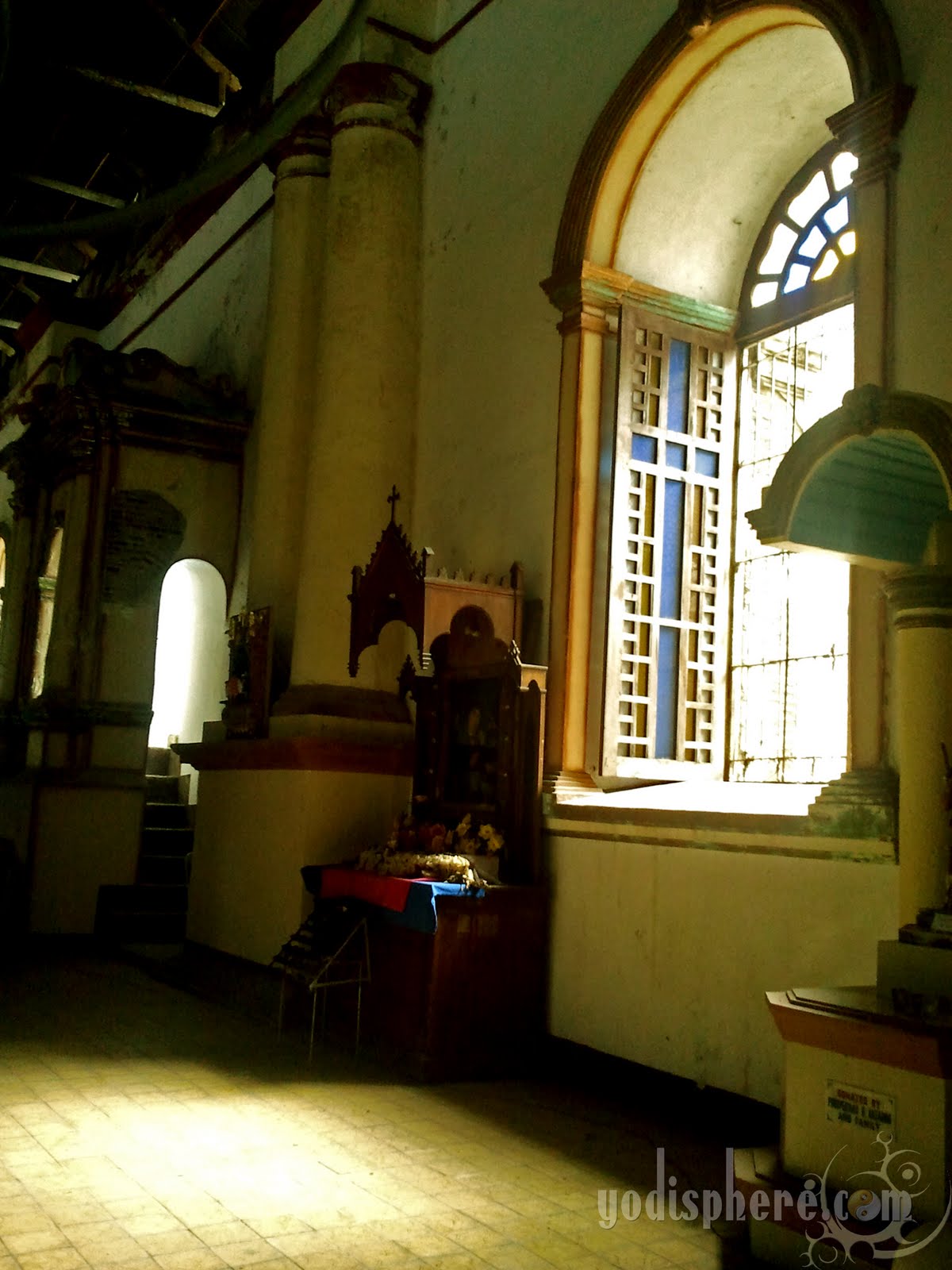

We, Filipinos are always trying to find what old memories look like… our obsession with heritage is always there, searching within the artificial and re-engineered versions created by our invaders.

Paoay Church does renders Ilocandia as forever enchanting and continues to make its visitors have a taste of past life back in times like in the decade when it was first completed.
 

Back in the days, when Filipinos are born pagans.


___________________________________
HERE ARE THE DETAILED POSTS ABOUT OUR  Ilocandia Time Travel


___________________________________
References and Citations:
» Wikipedia Entry “Paoay Church” [Retrieved: 05 September 2011]
» UNESCO Advisory Body Evaluation. Baroque Churches of the Philippines [Retrieved: 05 September 2011]
» Patrimonium-mundi.org : Paoay Church panophotographies - immersive and interactive spherical images
» St. Augustine. Aurelius Augustinus Hipponensis.  “De Civitate Dei contra Paganos [Concerning the] The City of God [against the Pagans] (Book III)]” Translated by Marcus Dods. From Nicene and Post-Nicene Fathers, First Series, Vol. 2. Edited by Philip Schaff. (Buffalo, NY: Christian Literature Publishing Co., 1887.) Revised and edited for New Advent by Kevin Knight.
» Boredpanda.com “50 Most Extraordinary Churches of the World
» De Jesus, Noel F. Manila Bulletin “Charms of the Old World” Posted: June 5, 2011, 10:58am [Retrieved: 05 September 2011]
» The Philippine Star. “Guling Guling of Paoay: Truly a galing galing festivity!” Updated March 06, 2011 12:00 AM [Retrieved: 05 September 2011]
» Rene Guatlo “Paoay sways to Guling Guling” Inquirer Lifestyle. Philippine Daily Inquirer. 03/15/2009.
» CBCP News “300-year old Paoay Church to get facelift” Posted: March 15, 2011
» ALL PHOTOS on this post are taken by the author YODZ Insigne via Samsung Galaxy S Smartphone 


Tuesday, April 12, 2011

Ilocos Tour » Sinking Bell Tower and McDonalds’ Rising Golden Arch

Laoag was still slumbering when we arrived at around 5:00 am. We made a quick stop at the Laoag City Central Plaza at the foot of the magnificent Don Mariano Marcos Bridge also known as Gilbert Bridge and the third longest bridge in the Philippines. The only restaurant open was the ever-present McDonalds. It’s a good thing this McDo branch has free WiFi - literally our one hand was holding our smartphones updating status on Facebook and Twitter, the other hand was doing the most important thing in the morning, which is breakfast. (Seems crazy because Facebook and Twitter are now vying for the most-important-thing in the morning category.)

With full stomach and Facebook status updated, we are now ready for a quick plaza tour. We first checked out the St. William the Hermit Cathedral and the Sinking Bell Tower.

Defying time - St. William the Hermit Cathedral

According to the church’s historical marker, St. William the Hermit Cathedral, was first built in 1580 as a wood and thatched nipa palm chapel. The present Italian Renaissance and Baroque-style church was built between 1650 and 1700. It has stood the test of time, while silently witnessing the unfolding of Philippine history during the Spanish era. It was seriously damaged during the November 14, 1707 earthquake, partially destroyed by fire in 1843 and then completely restored. It was again damaged during the July 18, 1880 earthquake and repaired again. In 1891, the roof of the church and convent were replaced with galvanized iron.

Alpha & Omega symbol at the church entrance
The church was occupied by Pedro Almazan in 1661, revolutionaries in 1896, American forces in 1899 and Aglipayans in 1901. It was the scene of the 1932 diocesan Marian Congress and was slightly damaged during the September 7, 1983 earthquake.

The painted Cathedral
It was totally damaged when they PAINTED it. Old church walls have a quiet faded beauty, but in the case of this church, it is impossible to see now because of the modern paint. The paint obscures the architectural details and history of the church.

They should’ve leave the bullet holes and cracks on the church walls to remind us that Ilocanos have fought a war and died to save Ilocandia. I say they should’ve think twice before repainting the church that has achieved lovely old walls after many centuries.

By re-painting this cathedral, they hide its century old beauty and erased the mark of hardships of the early Philippine revolutionaries fighting for independence.


Unto Earth returnest – The Sinking Bell Tower

Around the corner, at the back of McDonalds right across Bonifacio St., in the northern end of Don Mariano Marcos Bridge and meters away from the St. William the Hermit Cathedral is the immemorial Sinking Bell Tower also called the Bantay Bell Tower. The tower is located about 85 meters away from the cathedral, a colonial church feature described as “earthquake baroque.”

View of the Sinking Bell Tower from the Cathedral
The cathedral’s Bell Tower, was previously one of the most massive and tallest in the country. Built even before the foundations of the cathedral were laid (around 1660). It is made of bricks, joined by molasses and the juice of sablot leaves mixed with lime and sand. I think that is more economical than using egg white just like what they did in constructing the Baclayon Church in Bohol.

The belfry now leans slightly to the north and has sunk half a storey since its construction, allegedly due to the 1957 earthquake and its being built on a sandy subsurface.

According to the locals, a man and a horse can go inside the tower before but now a man can no longer pass through its gate.

The new belfries

This place makes me think back about how times have changed. Commercial and modern establishments are now drowning the Bell Tower making it out of sync with the new world. You can no longer take a nice clear photo of the bell tower because electric posts are blocking the view. Aside from the fact that it is sinking, it seems like disarrayed webs of electric wires are also strangling it. Hmmm, melancholia nostaglia.

While the belfry is bidding its final farewell, slowly sinking every year, McDonalds’ golden arch and tower is happily rising, as if mockingly saying “you’re history, get lost!"

The church must stop politicking and instead exert extra effort in evangelizing because more people are having salty French fries more often than taking the bland holy bread.

Nowadays, McDonalds’ towering golden arches are the new belfries.
What do you think?


HERE ARE THE DETAILED POSTS ABOUT OUR  Ilocandia Time Travel


_______________________
Fact Sources and Citations: 
» Grele Dominique, Jouve, Lily. 2001.100 resorts in the Philippines: places with a heart “Loag and its environs” Asiatype, Inc.:96
» Peplow, Evelyn.1997.The Philippines.Sinking Bell Tower of Ilocos.McGraw-Hill: 156
» Coseteng, Alice M. L., 1931- “Eartquake Baroque” Spanish churches in the Philippines.UNESCO National Commission of the Philippines, 1972
» Wikipilipinas. “St. William's Cathedral” http://en.wikipilipinas.org/index.php?title=St._William%27s_Cathedral [10 April 2011]

Thursday, March 3, 2011

Cebu Metropolitan Cathedral Images » Mobile Things To Do While in Cebu City

The Griffin at the Cathedral's pediment
This is my noob attempt at phontography and SGS photowalk during our recent Cebu City visit. Although SLR camera is still the best at capturing images, always carrying it around is a real drag. We are now living a high-tech world where “convergence” is everywhere. Gone are the days when a point-and-shoot camera was a camera, an MP3 player was an MP3 player, a mobile phone was a just a phone.

I got some savings for a DSLR camera last year, but I end up buying a smartphone because I realized I need it more than an SLR. However, I’m planning to buy one if I have that extra budget again - I’ll try phontography in the meantime. They say phontography is the next generation revolution in point-and-shoot photography because every second somewhere in the world a picture is being clicked using a mobile phone and being immediately uploaded on the Internet.

I was browsing the net on this subject and came across “Cellular Obscura,” the mobile phone photography blog by Shawn Rocco, photojournalist for the News & Observer in North Carolina. The blog is emphasizing the notion that it's not always the quality of the camera that counts, but the artist behind it. Really inspiring!

I want to dig on this subject on the coming weeks. Now here’s my first attempt at phone photography using my Samsung Galaxy S featuring the Cebu Metropolitan Cathedral.

Cebu Metropolitan Cathedral »The Bishop’s Throne

Ancient church tradition dictates that the local ordinary or bishop wields his power from his throne, the seat of the archdiocese. This was reflected in the Cebu Metropolitan Cathedral, which has a “throne” or seat made of marble located on the left side of the altar for the politically powerful His Eminence Ricardo Cardinal Vidal.

Aside from entailing authority the Cebu Metropolitan Cathedral is the symbol of unity of the church, the “unifying factor” in Cebu province.

"Seat of Power"
Cebu Metropolitan Cathedral is shaped into a cruciform with thick walls that were built to withstand typhoon and other natural calamities. Inside the church, a large dome sits upon the pillars of the transept, accenting the barrel vaulted ceiling. The convent now has balustrades to resemble Spanish era architecture.

"Cathedral Sentinel"

The church was almost completely destroyed during World War II. The remaining original structures are the belfry and the facade.

"Holy Grandeur"
The cathedral is a typical example of a baroque colonial church. When you enter, you will see an old design but it is devoid of ceiling murals typical in old Bohol Churches. 

"Mute Belfry"
During World War II, much of the cathedral was destroyed by Allied bombings of the city. Only the belfry (built in 1835), the facade, and the walls remained. It was quickly rebuilt in the 1950s under the supervision of architect Jose Ma. Zaragosa.

"The Power of the Golden Orbs"
The cathedral also underwent a 30 million peso renovation for the 75th anniversary celebration last April 28, 2009.

"Lungkot-lungkutan"
That's it! These photos are all from my Samsung Galaxy S phone. I used some built-in phone camera adjustment and scene selections while capturing these  images and do some light and color enhancement in photoshop. 

I'm a real noob at photography and I want to learn the basic tricks so I will be busy reading phone photography articles in a few weeks.

Also if you can help me in any way, I'll appreciate that. Please share your inputs or suggested readings on the comments section.

Thanks in advance!!!

.   


Wednesday, October 6, 2010

Bohol Tour » The Nostalgia and Elegance of Bohol’s Famous Old Churches

Aside from its amazing natural beauty, Bohol is also home to a numerous historical stone churches, ancient watchtowers and Spanish era convents with great frescoes. Bohol’s vibrant tourist industry brought us, together with other travelers, on quick walking trips to these sites, which is somehow, is their way of telling us some snippets of their old history. We visited four churches in Bohol – Baclayon, Dauis, Loboc and Panglao Church. The impression these churches gave me is that visiting these sites was done for bland relaxation, picture taking and art appreciation.

However, my experience of doing this Visita Iglesia, which was supposed to give me lectures of the old life, always gave me this nagging desire to search for origin, purity and silence, amidst the apparent aimlessness and whimsy of modernity. Yet, these thoughts had taken a rather peculiar turn; it seemed to me that these churches was still there, not because of hosts of other reasons, but largely to thank God for not destroying the world at the turn of the century. Yes I know, that is the profane attitude of the modern religious elite, which I am not.

Baclayon Church: The Church of Our Lady of the Immaculate Conception 

The sun was at its noon peak when we reached the Baclayon Church. The church’s open area on the left side, used as parking space for visitors was almost full- a blasphemous presence of modern things against the century old structure. I learned that Baclayon is one of the oldest churches in the Philippines - from the looks of it, I will not challenge that. The structure looks like the wall of Intramuros in Manila. Inside the church are colorful frescoes and some centuries-old relics and artifacts, which are all religious in nature.
According to Regalado Trota José, a well known art historian and author of the book "Visita Iglesia Bohol", some 200 native forced laborers constructed the church from coral stones, which they took from the sea, cut into square blocks, and piled on to each other. They used bamboo to move and lift the stones in position, and used the white of a million eggs and lime as to cement them together.

Our driver/tour guide told us that there is some mysterious phenomena happening here in the church. He showed us the supposed replica of the face of Saint Pio, the first stigmatized priest in the history of the Church, appearing in one of the pillars at the side of this centuries-old church. He said this is what continuously amazes the visitors here, so we immediately took our pictures with the supposed image as our backdrop. Well, for a non-devotee, this is nothing more than a natural anomaly.

We thought the church was closed, and we can only looked at it outside but there is an entrance via the sacristy. The church has strict policy on proper attire inside the church. According to the reminder posted on the entrance, “The sacredness on the Eucharistic celebration urges all participants to dress, manifest the importance of what they are doing.”

Don’t fret if you are on you usual tourist outfit. You can still enter the church because they will give you a large bandana to cover your voluptuous cleavage and legs – (so as not to distract the boys in their meditation.)

Church of Dauis: The Church of Our Lady of the Assumption
Located in the town of Dauis, three kilometers from Tagbilaran City, Dauis Church is truly one of Bohol's beautiful churches. Despite a semi-modern façade it has retained its Spanish architecture, with Romanesque and Byzantine influence. The interior has life-like murals painted on the ceiling. Beautiful frescoes painted in 1916 by a painter named Ray Francia decorate the entire ceiling of the church.


A local guide directed us to the enclosed well, called the Mama Mary's Well, at the foot of the main altar. She said the well is known for its healing power. According to the local history, this well originated from the Spanish era. Pirates often attacked Christian settlements and it was during one such attack that the people took refuge behind locked doors of the church. Besieged by the enemy for days, the people run out of food and water. The well miraculously sprang up and since then has become the source of drinking water for the populace nearby, especially during droughts. The water tastes truly fresh, despite the well’s closeness to the seashore.

Water from the well is available in bottles for free but you can give cash donation if you want. Your religious Mom or your Lola will love it as your take home gift (pasalubong). Just don’t forget to tell them that it is a special miraculous water. 

Loboc Church: The Church of San Pedro

We came across this church on our way to Loboc River for our Buffet Lunch Cruise. Actually the church is picturesquely located by the banks of the Loboc River. But due to our limited schedule, we haven’t had the time to explore the church and its adjacent museum.

According to the National Commission for Culture and the Arts (NCCA), Loboc  church was built in the 17th and 18th centuries by the Jesuits, with enlargements in the 18th and 19th centuries by the Augustinian Recollects, and painting added in the early 20th century. The 17th century Jesuit church was later converted into apart of the three-level convento while the present church dates from the 18th century, with 19th century additions such as the belltower, the porticoes, and the funeral chapel. The convento is the only one in the country with three levels.

San Agustin Church and the Panglao Watchtower

The church of St. Augustine is 18 kilometers from Tagbilaran City, lying on the southwestern side of Panglao Island. The massive stone church is nestled on a plain, its back to the seashore and its right side facing a big, wide plaza which is the venue of the town’s many religious and social activities. We didn’t have the chance to go inside the church because of an ongoing funeral service.
Instead, we just checked out the nearby Panglao Watch Tower, which is a 5-storey bell tower built of cut stone in 1851. Octagon in shape and covered by a pitched roof, it is said to be the tallest of its kind in the Philippines. Well I don’t know how many are there in the Philippiines – maybe two? Ha ha.

They said from this tower, you can see the islands of Siquijor, Cebu, and Negros, and, with clear weather, Mindanao and Camiguin. Also the tiny islands close to Panglao, such as Balicasag Island, can be seen from this tower. However, the tower is in ruin now and is in dire need of repair. Based on its current state, I guess they are just waiting for its total collapse, for them to consider repairs.

There are other elegant churches in Bohol but you need extra day to visit all of it. If you are planning to visit Bohol, include a quick stop on these sites aside from the Chocolate Hills – you won’t regret it. 

_________________