Showing posts with label ilocos norte. Show all posts

Wednesday, September 7, 2011

Paoay Church in Ilocos Norte » Architectural Heresy and Our Obsession with Heritage

I had already poked my head into enough elegant churches in Bohol and other old towns in the Philippines but I should not miss Paoay Church, although I used to think all Spanish-era churches in the Philippines are alike. San Agustin Church in Ilocos Norte, popularly known as Paoay Church is definitely unique.  

The uniqueness of this church lies in the unceasing nature of its struggles against time and the history it depicts, in its dramatic architecture and the mysterious heresy hidden within its elaborate brick design.
 
I approached the church from a nearby dry and impotent brick fountain, excited like a virgin bride walking at the long patio decorated by white bougainvilleas at each side. Waiting for me at the other end is the pyramidal and deliberately flat church façade like an unlit altar, gray yet graceful against Ilocandia’s arid air. Above me are dark clouds stripped of its silver lining, painted like the church’s high frescoes, tragic like the life of Judas.

View of Paoay Church from the fountain
But halfway through the patio, I heard it. This church is whispering heresies of the past. Its fourteen buttresses are like old papyrus, documenting the fusion of the conquistadores and the pagans.

Sic transit gloria mundi,” thus passes the glory of the world, wrote the monk Thomas à Kempis. The survival of churches through time, architecturally and historically, is a subject matter for the architects and historians. My reaction or theory about this specific church, about it being architecturally heretic is mine alone. But let me expound.

Paoay Church history


The Official Marker: WORLD HERITAGE SITE, Church of San Agustin Paoay Ilocos Norte. One of the four Baroque Churches of the Philippines inscribed in 1993 on the World Heritage List pursuant to the 1972 UNESCO Convention Concerning the Protection of the World Cultural and Natural Heritage. The Church of San Agustin possesses exceptional universal value the deserves protection for the benefit of humanity. 
Paoay Church is part of the UNESCO World Heritage List, under the Philippines four Barqoue Churches collection composed of San Agustin Church in Manila, Nuestra Señora de la Asuncion in Santa Maria, Ilocos Sur and Sto. Tomas de Villanueva Church in Miag-ao, Iloilo. It is currently a property of the Diocese of Laoag, Ilocos Norte.

Church main altar and roof under renovation
According to the official historical marker at the entrance of the church, the parish was founded by Augustinian missionaries in 1593, cornerstone of church laid 1704; of convent, 1707; of tower, 1793. It was used before completion and kept in repair by the people under joint auspices of the Church and the town officials. An inauguration ceremony was held 28 February 1896.

The bell tower
It was damaged by earthquake in 1706 and 1927. Katipuneros used its tower as observation post during the Revolution and by Guerilleros during the Japanese occupation in World War II.    

The massive coral stone bell tower, which was added half a century after the church was completed, stands at some distance from the church, again as a protection against damage during earthquakes.
According to historians, the bell tower also served as a status symbol for the locals. The bell would ring more loudly and more times during the wedding of a prominent clan that it would during the wedding of the poor.

Earthquake Baroque

As reported by Jorge Gazaneo of ICOMOS, “Philippine church is a completed example of one are peiod, but a living document of how time and context have left traces on the early founding intentions of the original designer-builder… on the cross roads of different cultures – Malay, Chinese, European, American, Mexico-Peru – the architecture and art of the Philippines should be valued on standards different from those developed by European Scholars…Unity and authenticity are difficult to be expected in theis part of the world, a violent frontier knowing the ravages of war, heavy typhoons and repeated violent earthquake destruction.”

Paoay Church is the most outstanding example in the Philippines of 'Earthquake Baroque' due to its unique combination of Gothic and Oriental designs. Its façade reveals Gothic designs, its gables show Chinese elements, while the niches topping the walls suggest Javanese influence like the towers of the famous Boroboudur Temple in Central Java, Indonesia. It is interesting to note that the town of Paoay is called "Bombay" in early documents, in keeping with the legend that the earliest inhabitants came from India.

Javanese influence on the Church's buttresses like the towers of the famous Boroboudur Temple in Central Java, Indonesia.
It has fourteen buttresses ranged along the lines of a giant volute supporting a smaller one and surmounted by pyramidal finials. Its details are inspired by the seal of Saint Agustine, the emblem of the king of Spain, the logo of the Pope, the “init-tao” or the sun god, and stylized Chinese clouds.

Fusion of the obvious

Because of its difficult terrain, arid temperature and threat of earthquakes, Ilocos was once described as a “God-forsaken land” and it is said that you have to have the “patience of a spider” in order to survive it. But Ilocanos, hardy people that they are, not only survived in this formidable land but were able to turn this highland country into “God’s own paradise”.

It is but fitting that they dedicate their church to St. Augustine. Aurelius Augustinus Hipponensis (St. Augustine), the philosopher, spoke with mechanical fluency when he proved in his book “The City of God [against the Pagans] (Book III)]” that external and bodily disasters including moral and spiritual calamities are happening to the Romans; and that even when the false gods were worshipped without a rival, before the advent of Christ, they afforded no relief from such calamities.

 
Naturally, they build Paoay Church to withstand and defy acts of God. The Augustinians forced the naturally-born pagans to build this church. But these converts have their own memory and obsession with heritage, beliefs and superstitions, thus the Javanese, Chinese and Oriental influences in the design. 

Until now, the picturesque front garden of the San Agustin Church is being used for rituals known as the Guling-guling festival, an annual festivity that signifies the last day of merrymaking before the Catholic community's observance of the Lenten Season. There are those who conjecture that there is probably a pagan underpinning to the practice, similar to Valentine’s Day; the tradition that places the birth of Jesus in late December, the darkest time of the year; and the timing for Easter right after the vernal equinox. 

Paoay Church is truly the fusion of Catholicism and the pagans.


Final Note

New developments are under way for Paoay Church aside from restoration, which aims to make the province of Ilocos Norte the country’s “northern gateway.” To generate more tourist activities, the provincial government of Ilocos Norte announced a plan to put up a commercial arcade, which would feature the town’s unique products along a stretch of the road lining the Paoay Church.

Aesthetically, I don’t know if these commercial establishments will do any good, so you have to visit Paoay before it becomes a commercial-church. 
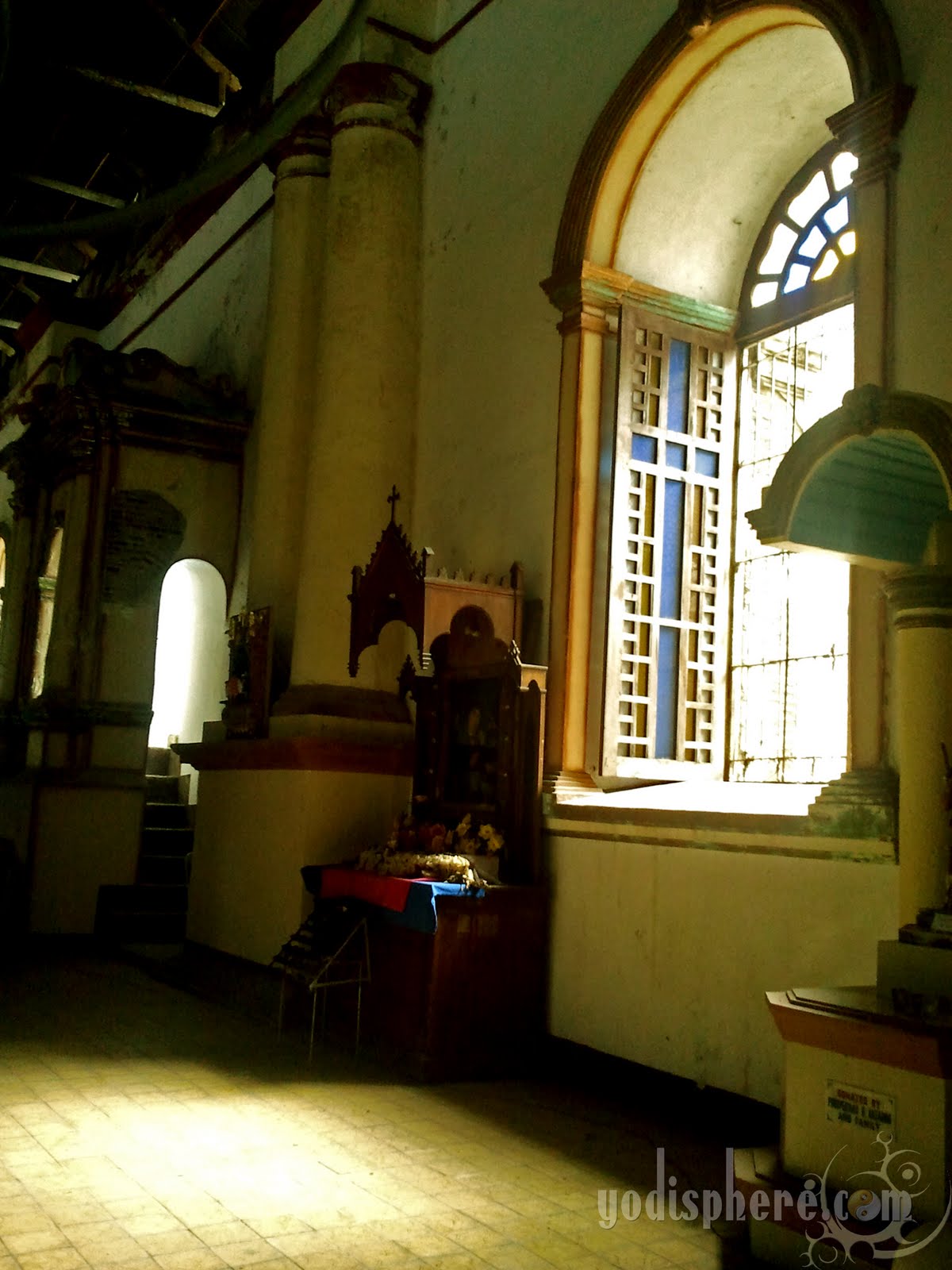

We, Filipinos are always trying to find what old memories look like… our obsession with heritage is always there, searching within the artificial and re-engineered versions created by our invaders.

Paoay Church does renders Ilocandia as forever enchanting and continues to make its visitors have a taste of past life back in times like in the decade when it was first completed.
 

Back in the days, when Filipinos are born pagans.


___________________________________
HERE ARE THE DETAILED POSTS ABOUT OUR  Ilocandia Time Travel


___________________________________
References and Citations:
» Wikipedia Entry “Paoay Church” [Retrieved: 05 September 2011]
» UNESCO Advisory Body Evaluation. Baroque Churches of the Philippines [Retrieved: 05 September 2011]
» Patrimonium-mundi.org : Paoay Church panophotographies - immersive and interactive spherical images
» St. Augustine. Aurelius Augustinus Hipponensis.  “De Civitate Dei contra Paganos [Concerning the] The City of God [against the Pagans] (Book III)]” Translated by Marcus Dods. From Nicene and Post-Nicene Fathers, First Series, Vol. 2. Edited by Philip Schaff. (Buffalo, NY: Christian Literature Publishing Co., 1887.) Revised and edited for New Advent by Kevin Knight.
» Boredpanda.com “50 Most Extraordinary Churches of the World
» De Jesus, Noel F. Manila Bulletin “Charms of the Old World” Posted: June 5, 2011, 10:58am [Retrieved: 05 September 2011]
» The Philippine Star. “Guling Guling of Paoay: Truly a galing galing festivity!” Updated March 06, 2011 12:00 AM [Retrieved: 05 September 2011]
» Rene Guatlo “Paoay sways to Guling Guling” Inquirer Lifestyle. Philippine Daily Inquirer. 03/15/2009.
» CBCP News “300-year old Paoay Church to get facelift” Posted: March 15, 2011
» ALL PHOTOS on this post are taken by the author YODZ Insigne via Samsung Galaxy S Smartphone 


Tuesday, August 23, 2011

Batac City, Ilocos Norte » Understanding the Final Argument of a Dictator's Town

My Ilocondia getaway seems rather uneventful in the retelling. I know. And it surprises me a little to say that my travel experiences in Ilocos has become a meaningful part of my summer which was rather really short and scorching, maybe because of climate change or maybe because it is naturally hot in Ilocos. I review my Ilocos tour blog posts and realized that they are sprinkled with subtleties – an unconscious way of looking at things and at life. The reason maybe has as much, or more, to do with life context as with the Province of Ilocos. Ilocandia makes me feel old and think old, and I like it.

It’s an odd thing, probably no decent Filipino would think or consider, but upon entering any old town in the Philippines with century old church at its center, I always felt that Filipinos don’t really have a nation as the Spaniards or as the Japanese do. We are just a persecuted minority. That’s what they’ve done to us.
View of Immaculate Conception Church at Batac City Central square
 
However, upon entering Batac, the quaint town in the province of Ilocos Norte and hometown of many significant figures in the history of the Philippines, the seat of Marcos’ enigma, I realized that the fabric of Filipino society – the culture, rules and laws and customs that we lived by – is reflected in direct proportion to how many revolutions we had and how many uprisings we are still planning. When we pause and stop, that is the only time we will have a nation. When the Filipinos stopped being angry.

Marcos during wartime in the Philippine Army
Pardon me, but this is how Batac City makes me feel. I admit I’m born a little late for the revolution. I’m just a child then in Mindoro, happily playing and jumping at the haystack after the palay harvest oblivious of nuns and freedom fighters chanting Hail Marys against tanks in EDSA.

I don’t know why I feel this compulsion to understand – maybe because the body of the greatest leader for the Ilocanos and a usurper and dictator for the human rights victims lies here.

But wait, before we move on, let me grab one of those famous Ilocos Empanada and a bowl of miki at the Riverside Empanadahan.  [gutom lang siguro to.]
Batac Riverside Empanadahan

The Marcos Museum and Mausoleum

There is something about my Batac experience that I find disturbing. It is the famous preserved body of the late Philippine President Ferdinand E. Marcos in a refrigerated glass crypt for public viewing – which, to my surprise is actually a wax!
Marcos has a wall dedicated to Marcos' wartime service in the Philippine Army, as a soldier in the defense of Bataan and with American Forces after liberation. There are also photos of him and Imelda, his military awards, his letters, important documents, license plates of his cars, the bust of the president and his work desk at Malacanang.
The Marcos Museum is a large stately tomb supposedly housing Marcos’ embalmed remains, which is contained in a vacuum-sealed glass coffin. It is the first structure seen from the main street and is the one, which follows the lines of a Spanish wood-and-brick house, with solid ground floor walls and an upper storey of wood decorated with floral carvings. The Mausoleum is a cube of adobe blocks and is stepped towards the top of the structure. Its centerpiece is the body of Ferdinand Marcos encased in glass, dressed in a white barong tagalog with a red, white and blue ceremonial sash and polished medals. The dark interior is divided into a square path lining the elevated glass coffin with white capiz flowers and shells underfoot. The dark echoing room is eerily filled with Gregorian chants like summoning Ferdinand to come alive.   

It would be hard to classify me as credulous and uncritical – because I firmly believe that – with the right level of common sense, you can instantly know what you’re looking at. Some insisted it’s the actual body of Ferdinand Marcos, but let’s face it, those who are saying it are blind loyalists. See it for yourself.
Batac World Peace Center and Photo Gallery  
A few blocks away from the Mausoleum is the Marcos Photo Gallery (World Peace Center), a photo archive of the Marcos family which include a collage of news clippings and photos during the Marcos era. 
Gregorio Aglipay Monument and Church
Across the gallery is the Iglesia Filipina Independiente Church, which was founded by Msgr. Gregorio L. Aglipay. Gregorio Aglipay was a former Catholic priest who, due to his support for the Philippine Revolution, was excommunicated and later on founded the Philippine Independent Church aka the Iglesia Filipina Independiente (IFI).

The final argument


The title of this post caused me a lot of trouble. I thought it was brilliant like the treason of the intellectuals theme but unfortunately when I came to write the body to go with it, I found difficulty in making a match – maybe because I am not there at the EDSA revolution. For a while it seemed that my post was leading only to Batac and understanding Marcos and its symbolism but it did give me reason to traipse around Aglipay Shrine, meet peace loving and friendly Batacqueños, have a bite of their famous Empanada, miki and bagnet.

I gathered a fair amount of sense of history on my short stop to Batac City. There is, however no time to go into analysis of the contrasting beliefs of Marcos’ state funeral at the Libingan ng mga Bayani, and of the distinct political and religious circumstances and debate surrounding the Marcos-Aquino-EDSA names.

But one thing is for sure, Batac is still a loyalist, forever arguing that no dictator ever lived in the Home of Great Leaders. Visit Batac so you’ll understand.

    
____________________________________
Batac City Ilocos Norte Quick Facts:
  • Batac is located in the mid southwestern portion of the province of Ilocos Norte.
  • The town was founded by the Augustinians in 1587 under the patronage of the Immaculate Conception.
  • The word "Batac" in a local dialect translates as "pull". More loosely, it refers to "the people's pulling their efforts together."
  • Travel time by motor vehicle at this time is very convenient because of well paved roads and is 15 to 20 minutes to Laoag City and 8 to 9 hours to Metro Manila.
  • On February 2011, the supreme court upheld the cityhood of Batac
  • Major event is the of City Charter Day which highlights the Empanada Festival, a showcase of the famous product- the BATAC EMPANADA held every June 23rd.
________________________
HERE ARE THE DETAILED POSTS ABOUT OUR  Ilocandia Time Travel
 
____________________________________
References:
»  Official websiteof the City of Batac: http://www.batac.gov.ph/
» “Batac” Wikipedia Entry: http://en.wikipedia.org/wiki/Batac

Tuesday, March 29, 2011

Ilocos Tour » Laoag-Pagudpod-Vigan Impromptu Weekend Getaway

I say unplanned trip is way better than planned one, maybe you won’t agree. But for me, those quick getaway trips are more gripping and remarkable especially if it’s one of those arbitrary barkada gigs. That’s the beauty of randomness – always tickles our unconscious desire for chaos. We always have that hidden desire to escape routine and a wish for that sudden bump on a boring road.

Conversely, best-planned trips are always impacted by cancellations. Of course we all know how safe and sane it is to plan a vacation in advance: we save for the expected expenses, cheap resort is booked, itinerary is neatly pre-decided and vacation leave is filed. There is no way the trip could go wrong. However, I don’t know if it’s just us (I mean our backpacker group), but most of our long planned barkada gigs are always being cancelled.

We all have that occasional urge for a quick break. And at this moment, we no longer care for a neatly planned trip. I find it amazing because if we are on a getaway travel mood, we always managed a really quick preparation and an exciting itinerary. It’s group dynamics I guess, and I’m lucky I got an awesome kaladkarin group – Thanks guys!

Planning an unplanned Ilocandia getaway

This, ladies and gentlemen, is what happened to us last weekend. We managed to have an Ilocos tour – which includes Laoag, Pagudpud and Vigan – in just two days!

But prior to our Ilocandia getaway, we all felt slightly intimidated because of not planning in advance. We all have valid reasons - fear of costly expenditures, uncertainty of not finding a proper resort or hotel, uncomfortable and tiring road trip, skepticism on transportation (and driver’s integrity) and lots of other reasons, hassles and barkada drama. (Is that right Anjho? Ha ha)

These haunt us until the day before our trip. But this is when sharing of ideas, group consultation, commitment and a little bit of common sense comes into play.

And before we know it, we are in ILOCANDIA!!!

Ilocos Tour – Laoag – Pagudpod – Vigan Two-day Barkada Trip

I want to share here how we managed to sneak out of Manila last weekend for a two- days-only weekend getaway.

Here’s our super itinerary and a sneak peek of the places we visited

Friday, 25 March 2011 – After work

8:00 p.m. Depart Manila going to Laoag

Saturday, 26 March 2011

Morning


  • 12:00 Check-in at Jun and Carol Beach Cottages - Pagudpud


AFTERNOON TOUR
  • Tour of Ilocos Norte – Southbound » Kabigan Falls Trekking » Patapat Viaduct » Agua Grande » Kalbario Patapat Natural Park » Timamtang Rock » Bantay-Abot Cave » Blue Lagoon » Swimming at Pagudpod Beach
  • Dinner and Peryahan trip at Pagudpud Town Plaza

Sunday, 27 March 2011

  • 8:00 AM Resort Check-out

  • Batac-Ilocos Norte Tour » Merienda at Batac Riverside Empanadahan » Marcos Museum » World Peace Center (Imelda Marcos Office) – Photo Gallery » Malacañang of the North (closed) » Quick peek at the Sand Dunes » Paoay Church


PM
  • 1:00 p.m. LUNCH at Grace’s Crib » VIGAN Ilocos Sur » Pagburnayan Pottery » Hidden Garden » Baluarte ni Chavit » Crisologo Street
  • 7:00 pm Back to Manila

28 March 2011 Monday
  • 3:00 am Arrive Manila
  • 8:00 am Back to work

Wallet Damage:

3,000.00 Pesos each (for 7 person)
Inclusive of:
Van rental and Driver’s Service Fee: 15,000.00 Php
Resort/Room Accommodation: 2,000.00 Php per room
Other Misc. Expenses (Entrance fees, toll fee, etc.)
Meals and budget for pasalubong not included.

My Tips for an impromptu Getaway Tour

Visiting all these places in just two days is really amazing – it’s like time travel. Now here’s a few tips I can give you if one of these days, you felt you badly need a change of weekend scenery.
  • 1. Do an ocular inspection of the place via the Internet: With the Internet and blogs, everything is at your doorstep. Collect as much information about your travel destination as you can. This would give you a preview and make you feel much comfortable and prepared for new place.
  • 2. Always look for cheap resort/hotel: There are always cheap hotels and resorts in every Philippine travel destinations with great service than can compete with known and famous hotels – always spend extra effort on finding them.
  • 3. Check your wallet: Last but not the least: make sure you have extra cash before you leave or a credit card might be handy. There’s always an unplanned purchases, I’m sure of that!

On my upcoming posts, I will share my experiences (and mobile photos) of each place we visited.

I will appreciate it if you could share your thoughts and experiences on having an impromptu and unplanned trips.

Until then folks, more of our Ilocos Tour soon!

___________________________
HERE ARE THE DETAILED POSTS ABOUT OUR  Ilocandia Time Travel